People ask me this question more than any other: "How do you run a full marketing agency by yourself?"
The short answer is that I do not do it by myself. I built a team. That team just happens to be made of software instead of people.
The system is called Platon OS. It is an AI operating system I built from scratch that runs 23 specialized agents, each one handling a specific function of the agency. Some of them work every day without me touching anything. Some of them need my input before they act. And a few of them are experimental projects I am still testing.
This post is the honest, behind-the-scenes look at what each agent does, what it cost to build, and which tasks are genuinely safe to automate versus which ones still need a human in the loop.
The Architecture: How It All Fits Together
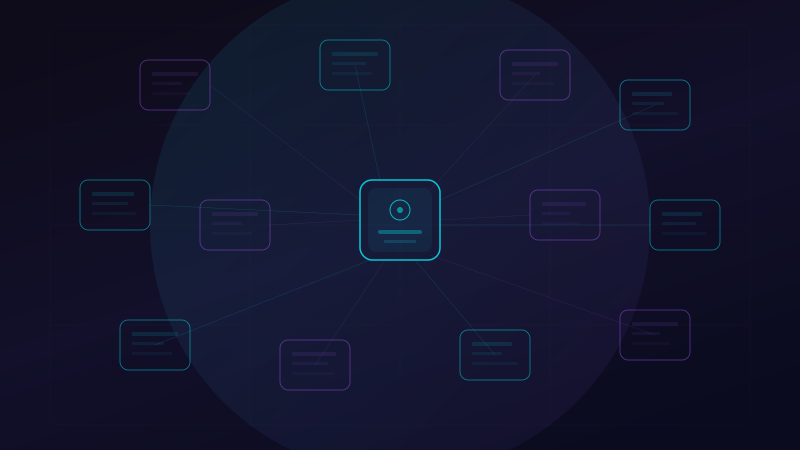
Platon OS is not a single AI chatbot. It is a system of 23 independent agents, each with its own job description, its own tools, and its own guardrails. When a task comes in, a router figures out which agent (or which sequence of agents) should handle it.
Think of it like a company org chart. There is a CEO agent that handles strategy and decision-making. A CMO that handles marketing plans. A CTO that handles technical decisions. They do not all activate for every task. The router is smart enough to know that "write a blog post about dental SEO" goes to the SEO agent, not the CFO.
The agents communicate through a shared context system, so when the prospecting agent finds a new lead, the email agent can draft outreach using the audit data that the browser agent collected. No copy-pasting between tools. No manual handoffs.
The Agents That Run Every Day
These are the workhorses. They run on a schedule, usually at 7 AM, and handle tasks without any input from me.
The Prospector. Every morning, this agent searches for local businesses in my target markets that have weak online presences. It looks for businesses with low review counts, outdated websites, or missing Google Business Profiles. It finds 3 to 5 new prospects per day.
The Browser + Business Agent Combo. Once the Prospector identifies a business, the Browser agent searches the web for detailed information about them. Their website quality, their review profile, their social media presence, their competitors. The Business agent then turns that research into a structured audit report with a lead score.
The Email Agent. After a prospect is audited, this agent drafts a personalized cold email using the actual audit data. Not a template. A genuinely personalized message that references real findings about their business. "I noticed your Google Business Profile has not been updated since 2023 and you are missing 12 leads per month to [competitor name]." These emails have a significantly higher open rate than generic outreach.
The Reply Monitor. This agent checks my inbox for responses to outreach emails and flags anything that needs my attention. It knows the difference between a bounce notification and an actual reply. When a prospect responds, I get a notification on my phone through Telegram.
The Agents I Work With Daily
These agents are powerful but need human judgment before they act.
The CMO. When I need a marketing strategy, a sales call script, or a client presentation, the CMO agent produces it. It researches the client's industry, analyzes their competitors, and builds a strategy document complete with timelines, pricing recommendations, and objection handlers. I review and adjust before anything goes to a client.
The SEO Agent. This one handles keyword research, blog post generation, and on-page SEO recommendations. It knows how to write for different industries because I loaded it with industry-specific keyword seeds. When I need a blog post about dental implants in West Covina, it produces a 1,200-word, SEO-optimized draft in about 90 seconds. I edit for voice and accuracy, then publish.
The Social Agent. Generates social media content calendars, hashtag strategies, and individual post drafts for clients. It knows which hashtags work for which industries and adjusts its tone based on the platform. I review everything before it posts.
The Proposal Agent. When it is time to send a prospect a proposal, this agent builds a complete, branded document with scope of work, pricing, timeline, and next steps. It pulls from the audit data and the CMO's strategy recommendations. I have closed deals with proposals that took me 5 minutes to generate and 10 minutes to review.
The C-Suite: Strategic Thinking Agents
These agents do not produce deliverables. They think.
The CEO Agent. Handles big-picture strategy questions. "Should I take on this client?" "Is this market worth entering?" "How should I price this service?" It thinks in terms of long-term value and risk, not just immediate revenue.
The CFO. Tracks costs, projects revenue, and keeps me honest about whether the business is growing profitably. It knows my API costs, my client revenue, and my margins.
The COS (Chief of Staff). Coordinates between agents. When I onboard a new client, the COS creates the client brief and makes sure every relevant agent has the context it needs.
What It Cost to Build
I built Platon OS over about three months of evenings and weekends. The total infrastructure cost is surprisingly low.
The entire system runs on my Mac Mini at home. The AI models are accessed through APIs. The daily cost to run all 23 agents, including the prospecting pipeline that runs every morning, is about $1 to $3 per day. That is $30 to $90 per month for what would otherwise require 3 to 4 full-time employees.
The development cost was my time. I am a developer by background, so I built everything in JavaScript and Python. If you hired someone to build a system like this, you are probably looking at $15,000 to $30,000. But the ROI is immediate and compounding.
What I Would NOT Automate
This is the section most AI articles skip, and it is the most important one.
Client communication. AI drafts my emails. I send them. Every client interaction goes through me because relationships are built on trust, and trust requires a human. My clients know they are talking to Andrew, not a bot.
Final creative decisions. AI generates options. I pick the right one. Whether it is a website design, a brand voice, or a campaign strategy, the human eye for "does this feel right" is irreplaceable.
Anything involving money. AI can recommend pricing. It does not set pricing. It can draft invoices. It does not send them. Every financial decision runs through me.
Quality control. Every blog post, every email, every proposal gets reviewed before it goes out. AI makes me 10x faster, but it does not make me unnecessary. It makes the human time I spend more valuable because I am reviewing and refining instead of starting from scratch.
The Real Competitive Advantage
The advantage of Platon OS is not that it replaces me. It is that it lets me focus on the 20% of work that actually requires human judgment while the other 80% happens automatically.
When a prospect runs an audit on my website at 2 AM, the system scores their business, identifies their gaps, and has a draft email ready for me to review by 7 AM. When a client needs a blog post, I spend 10 minutes editing instead of 3 hours writing. When I need to onboard a new client, the COS agent has a complete brief ready before the kickoff call.
The result: I serve 15+ clients, generate over $500K in revenue for them, and do not have a single employee. Not because AI is replacing humans, but because AI is making one human dramatically more effective.
If you are a business owner wondering whether AI can help you, the answer is almost certainly yes. But it is not about replacing people. It is about building systems that let your people focus on what they are actually good at.
Want to see the system in action? Try the free audit tool on our homepage. It is powered by the same AI that runs inside Platon OS.